Tuesday, 7 October 2014

Andrea Dworkin: Fairy tale representations

‘Woman Hating: A Radical Look at Sexuality’, written by Andrea Dworkin was published in 1974. A large section of this book is focused on the fairy tale and its meaning in our culture.

Female characters in fairy tales.
Dworkin discusses the roles that men and women play in Western fairy tales and their implications. For example, she identifies that females are particularly desirable when they are sleeping (some like Snow White and Sleeping Beauty are practically comatose). She also points out that good men are likely to fall under the influence of a powerful female and harm their children. (E.g. Hansel and Gretel)
Dworkin states; "The good woman must be possessed. The bad woman must be killed, or punished.  Both must be nullified.’
‘The roles available to women and men are clearly articulated in fairy tales. The characters are vividly described, and so are the modes of relationship possible between them. We see that powerful women are bad, that good women are inert. We see that men are always good, no matter what they do, or do not do.’ (The fathers in Cinderella and Hansel and Gretel are still described as ‘good men’ despite failing to protect their children from the evil female characters).

Dworkin on the ‘princess’ characters in fairy tales:
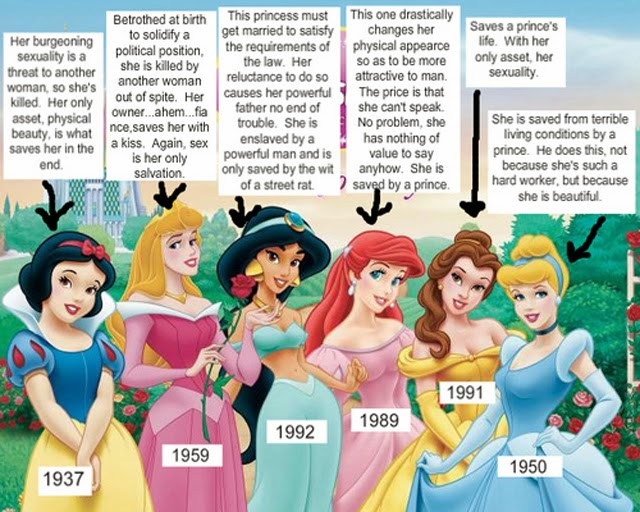
‘Cinderella, Sleeping Beauty, Snow White, Rapunzel - all are characterized by passivity, beauty, innocence and victimization.  They are archetypal good women - victims by definition. They never think, act, initiate, confront, resist, challenge, feel, care or question. Sometimes they are forced to do housework.’

Dworkin on mothers in fairy tales:
These fairy tale mothers are mythological female figures. They define for us the female character and delineate its existential possibilities. When she is good, she is soon dead.’
On stepmothers: ‘She is ruthless, brutal, ambitious, a danger to children and other living things.  Whether called mother, queen, stepmother or wicked witch, she is the wicked witch, the content of nightmare, the source of terror.
In her reading of ‘Cinderella’, she states: ‘Cinderella's stepmother understood correctly that her only real work in life was to marry off her daughters. Her goal was upward mobility, and her ruthlessness was consonant with the values of the market place.’  


Dworkin has this to say about the prince character in fairy tales:
‘He is handsome and heroic. He is a prince, that is, he is powerful, noble and good. He rides a horse. He travels far and wide. He has a mission, a purpose. Inevitably he fulfils it. He is a person of worth and a worthwhile person. He is strong and true.
Of course, he is not real, and men do suffer trying to become him. ‘


On the role of the fairy tale in our culture:
‘Women live in fairy tale as magical figures, as beauty, danger, innocence, malice and greed. On the personae of the fairy tale - the wicked witch, the beautiful princess, the heroic prince - we find what the culture would have us know about who we are.

The point is that we have not formed that ancient world - it has formed us. We ingested it as children whole, had its values and consciousness imprinted on our minds as cultural absolutes long before we were in fact men and women. We have taken the fairy tales of childhood with us into maturity, chewed but still lying in the stomach, as real identity. Between Snow White and her heroic prince, our two great fictions, we never did have much of a chance. At some point, the Great Divide took place: they (the boys) dreamed of mounting the Great Steed and buying Snow White from the dwarfs; we (the girls) aspired to become that object of every necrophiliac's lust - the innocent, victimized, Sleeping-Beauty, beauteous lump of ultimate, sleeping good. Despite ourselves, sometimes unknowingly, sometimes knowing, unwilling, unable to do otherwise, we act out the roles we were taught.’

Feminism Links:

Caitlin Moran on modern issues for feminism

Objectification  - effect on young women

Feminism and the C – word

Women objectified in advertising

Feminism Questions:

What is Feminism?
The belief that all men and women should be equal in all ways, social, sexual etc.

What is the objectification of women?
This is how women are presented in the media as sexual objects, mainly for no reason other that a male audience. This can be clearly seen in many rap videos such as Candy Shop - 50 Cent. Also it can be seen in advertising such as the recent Sheba cat food advert.

How can gender be seen as a social construct?


First Second and Third Wave feminism differences?
The first wave of feminism was in the late 1800s/early 1900s, and women were appealing for political quality, eg the right to vote. They used violent tactics such as invading parliament and hunger striking in prison to fight for womens equality. The second wave of feminism was in the 50s and 60s, and women were concerned with their social status against men, being known as the housewives and on less money than men at work. The women in the second wave of feminism fought for their equality against men in hierarchy above women. The third wave of feminism were concerned with the pressures placed on women in society today to conform to an un-achievable image. This took place in the 80s, 90s and 2000s and to some degree is still happening today.

Characteristics of femininity in fairy tales?
Female characters in fairytales are characterised as passive, beautiful, innocent and victimized, basically damsels in distress. This means that they are automatically set to be saved by the male lead role, who in every fairytale is seen as the hero (such as Cinderella, even though her father didnt protect her from her stepmother), who is portrayed as vulnerable from the beginning of the film. Another example of this is Rapunzel, who is seemingly strong to begin with but really has to rely on a man to make her way through the world. Jasmine from Aladdin also represents this as she is really of no political worth until she is married (relying on the male counterpart).

How can the portrayal of women in fairytales effect the real world?
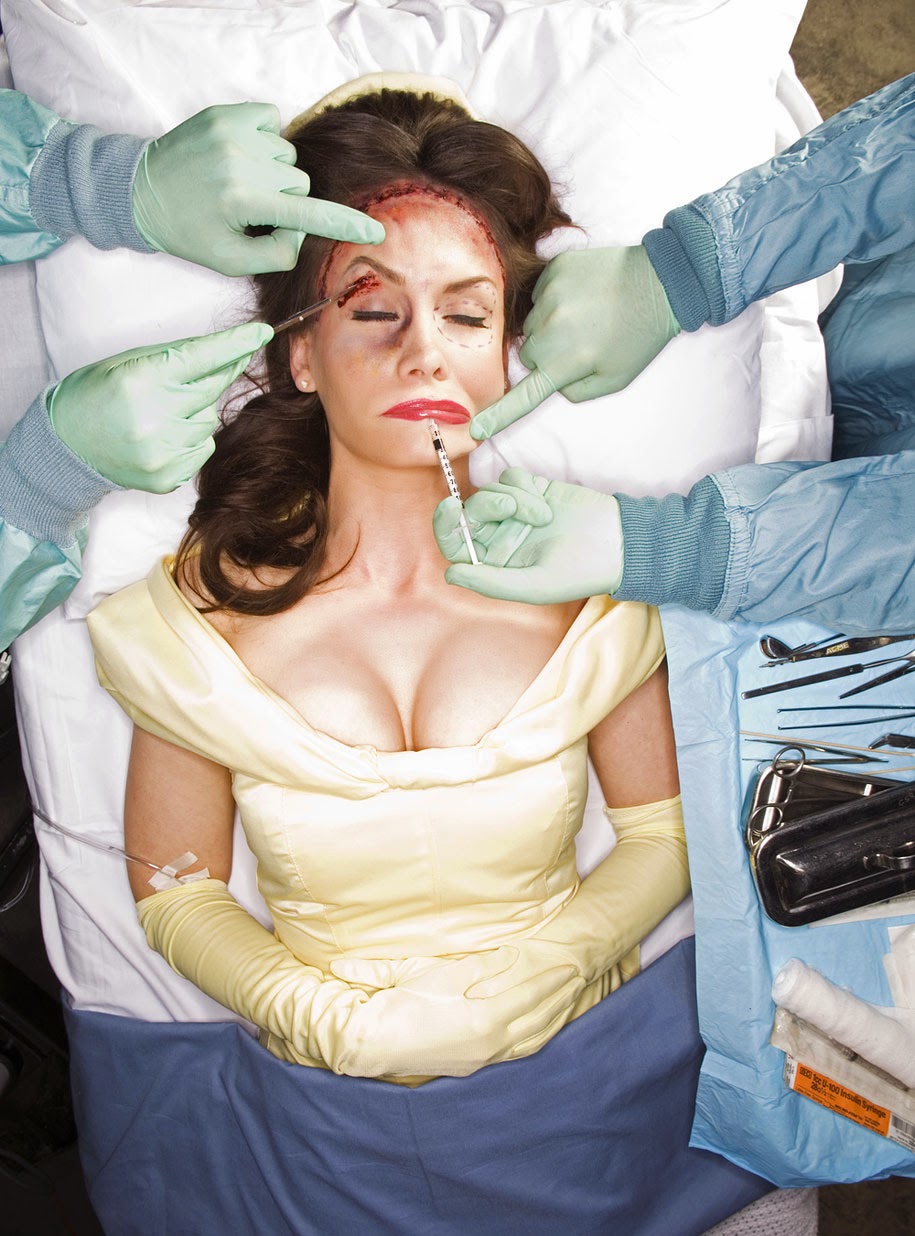
The portrayal of women in fairytale films, especially Disney, is a slim figured, big breasted and beautiful woman who unfortunately have to lean on their male counterpart to be secure in life. This message and representation is imprinted on us since children as Andrea Dworkin says, and therefore we grow up believing these stereotypes and so strive to be the 'princesses' we have always seen as role models. Women can get breast implants and force themselves to love a man in order to feel complete.

The 'Male Gaze':
The male gaze is the ideology that everything is seen through a males perspective in the media, such as through advertising and in magazines. This can be argued as the reason a lot of women are objectified in the media, as men would like to see big breasts and less clothing on a woman.

What does the male gaze suggest about power of genders in our society?
The male gaze suggests that men still have hierarchy in our society, as men would never be objectified to such extremes as women are today (through mens choice presumably). An example of this is Blurred Lines - Robin Thicke, where women are dancing on set naked to a song about rape. A feminist version was released as a parody, yet has no where near as many views and has been criticized by men for being too out of context. The original version is www.youtube.com/watch?v=yyDUC1LUXSU and the feminist version is www.youtube.com/watch?v=tC1XtnLRLPM

How are 'normative standards of beauty' formed?

Whats the difference between capitalism and normative standards of beauty?

How might these beauty standards affect womens health?

Wednesday, 24 September 2014

Important links for Postcolonialism continued

M.I.A - Born Free
http://vimeo.com/11219730

Public Enemy - Harder Than You Think
https://www.youtube.com/watch?v=fPHO5Brsd3E
http://www.azlyrics.com/lyrics/publicenemy/harderthanyouthink.html

White People Stole My Car - Racist Google Correction
http://loyalkng.com/2009/09/30/google-is-racist-white-people-stole-my-car-results-in-black-people-stole-my-car-wtf/

Complying to Angela Barrys Stereotypes:

Troublemaker: 
Chris Brown - I Can Transform Ya
www.youtube.com/watch?v=vFC1sUf4-Pc
Chris Brown & Rihanna - tattoo article
http://www.huffingtonpost.ca/craig-and-marc-kielburger/chris-brown-tattoo-_b_1885499.html

Media Spiral linked to Angela Barry's Stereotypes (Racism link)

  • Black people are seen in the media as 'troublemakers', 'entertainers' and 'dependents'.
  • Blacks being shown as troublemakers by the media can urge many more black people to become troublemakers to fit their stereotype.
  • Media can then cause a hype about the amount of troublemakers there are which causes a moral panic.
  • People become scared of the situation and therefor attempt to be like troublemakers too.
  • More people are living up to the stereotype of blacks in the media because they are scared of the exaggeration of the situation, therefor the cycle continues as more people panic as the media panics.

Wilkins' Media Amplification Spiral

The media amplification spiral is a theory that suggests that mass media take issues out of context, and therefore cause a long chain of events from the one exaggerated story, for example knife crime.

  • A small group of people commit a crime.
  • The media’s values pick up on an ‘interesting story’ and a ‘problem group’ is identified. 
  • The media produce headlines, stories and photographs to interest readers and viewers. 
  • To maintain readers’ interest, the crime is taken out of context through exaggerated reporting.
  • People become scared of the people committing the crime, so join the people committing crime. 
  • A moral panic develops. Public concern is aroused at the real or imaginary ‘threat’ to society; the media campaign for ‘action’ to be taken against this perceived threat. 
  • More social control – politicians, police and magistrates respond to public demand as shown in the media, and law-and-order campaigns are begun to stamp down hard with deviants. 
  • More crime happens as people are scared of it, so more people carry knives etc to protect themselves, and the process repeats.

Tuesday, 9 September 2014

Angela Barry's identification of stereotypes


Angela Barry identifies 3 stereotypes commonly used to represent black people in the media. Firstly, Angela identifies the 'troublemaker' stereotype as one associated to blacks in the media. The people who are given this representation may or may not be a trouble maker, but they are given only this representation, and so the audience do not think anything different of them. This theory can apply to many black people such as Chris Brown, who is nearly always a dominant troublemaker through the media (such as the Rihanna incident) and his drug use etc. Also, the London 2012 riots were seen by most of the nation via the medias representation, which dominantly showed black males as the main rioters.


Additionally, Angela identifies blacks to be stereotyped as the 'entertainer'. This carries connotations that these people are not 'intelligent' or 'sophisticated' enough. People that this may apply to can be music artists like Nicki Minaj or Pharrell Williams, or comedians/tv stars such as Kevin Hart, Lenny Henry and Will Smith, and maybe even sports stars such as Lewis Hamilton and Ashley Cole.

The last stereotype that Barry identifies as representing blacks in the media is 'dependent'. This means that black people are seen in the media as not being sufficient for themselves and always depending on people of white culture. This can include tv advertisements such as WaterAid, where only black people are featured and represented as 'desperate' and 'in need of help' from us. This is a false representation of black people as most are self-sufficient, but representations like this give white cultures the impression that the whole continent of Africa is dependent on our help and input.